
If you wake up every day with bites on your arm or neck and keep finding tiny rust-colored spots on the sheet, you probably have bed bugs. Your first step is to confirm it by inspecting the mattress, before you buy any pesticide. Once you’re sure, remember this above all: eggs are what bring an infestation back, so any treatment has to be repeated or followed up until every egg has hatched and died.
This article follows the order you’ll need: identify the insect, confirm it’s there, understand the bites, then start treatment. In a hurry? Skip straight to “A plan for getting rid of bed bugs at home.”
What bed bugs look like at every stage
An adult is about the size of an apple seed, 5 to 7 mm long. The body is oval, flat, and brown. It has no wings, so it can’t fly or jump. After feeding, the body swells and lengthens and the color turns reddish, which is why you might see two bugs of the same species and assume they’re two different insects.
The young ones are the real trouble. A newly hatched nymph is clear or yellowish white, and the smallest are about 1.5 mm, so you may not spot one with the naked eye if it hasn’t fed. The egg itself is the size of a pinhead.
| Stage | Approximate size | Appearance | What to watch for |
|---|---|---|---|
| Egg | 1 mm | Pearly white | Stuck in cracks and hard to remove |
| Small nymph | 1.5 to 2.5 mm | Clear or yellowish | Hard to see before feeding |
| Large nymph | 3 to 4.5 mm | Yellowish turning brown | Looks red after feeding |
| Adult | 5 to 7 mm | Brown and flat | Like an apple seed |
Insects people mistake for bed bugs
Plenty of people send in a photo of an insect, sure it’s a bed bug, and it turns out to be a carpet beetle or a small cockroach. The quick way to tell is location and shape. Bed bugs are flat with no visible wings, gather close to where you sleep, and leave black dots and blood behind. If you’re not sure, stick the insect on clear tape and take a good photo in the light. A clear photo can save you the cost of the wrong pesticide.
The bed bug life cycle, and why this takes time
A female lays one, two, or more eggs a day and can reach hundreds over her lifetime. Eggs hatch in about a week at normal room temperature. A nymph sheds its skin 5 times before it matures, and it has to feed on blood before each molt. In the right conditions it can become an adult in just one month.
Those numbers explain the complaint we hear most: “I sprayed, it was over, and a few days later they were back.” What happened is that the spray killed what was exposed, while the eggs in the cracks carried on and hatched a week later. So those new bugs probably didn’t come from outside. They’re the generation that was hiding.
Bed bugs can also handle hunger. In buildings with moderate temperatures they usually live 1 to 4 months without food, and in cold weather possibly much longer. So if you leave the apartment for two weeks at a summer resort, assuming they’ll starve, they’ll be waiting for you when you get back.
A single meal takes 3 to 10 minutes, and then the bug goes back into hiding. That’s why they’re hard to catch while you’re awake, and why so many people spend months not knowing what’s biting them.
Signs of bed bugs in your home
Bites alone aren’t enough proof. Many people show no mark at all, and in others the mark can take up to 14 days to appear. The stronger evidence is what you find on the mattress and furniture:
- Rust-colored spots on the sheet or mattress cover, usually blood from a crushed bug or one that just fed.
- Small black dots, like ink, in mattress seams and bed cracks. These are bed bug droppings.
- Empty, see-through skins that nymphs left behind as they grew.
- Live bugs in the folds of the mattress and sheets.
- A sweet, musty smell in large infestations. If you notice it, the numbers are probably high.
How to check for yourself in 20 minutes
Wait until you have some free time, then grab your phone flashlight and an old plastic card.
- Take the sheets off gently and check them in good light before putting them in a sealed bag.
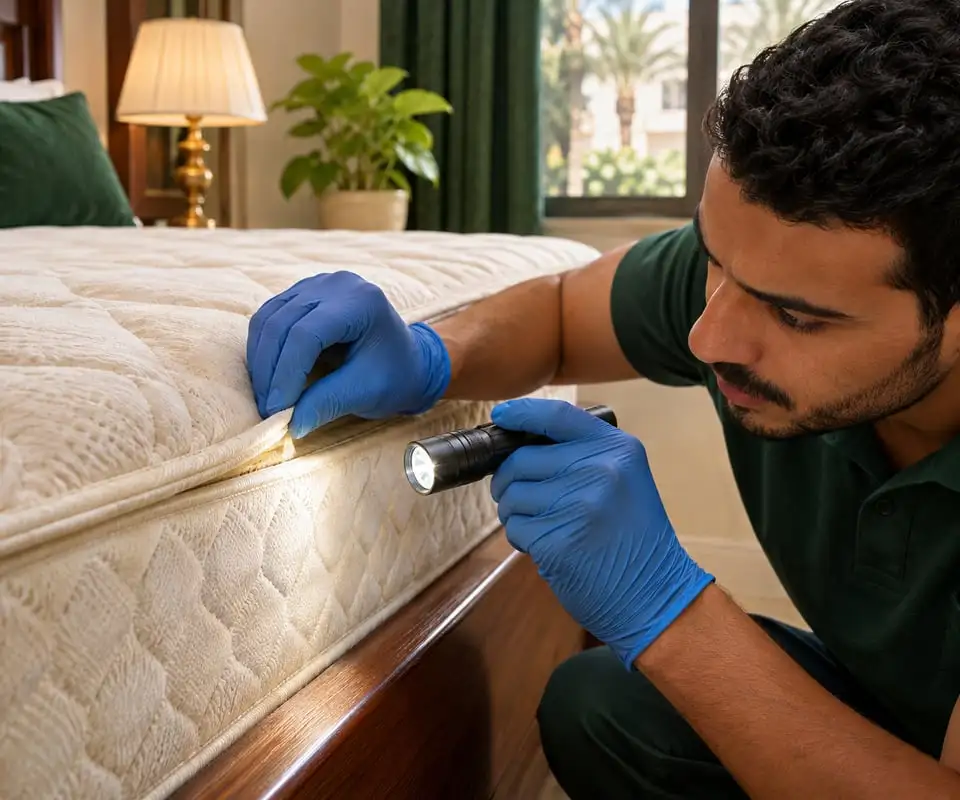
- Go along the mattress seams edge by edge, especially at the corners and under the brand label.
- Lift the mattress and check the bed base, the wooden slats, and the screw holes.
- Run the card through narrow cracks. A bed bug can fit in a crack no wider than a toothpick, and the card will push it out.
- Check the back of the headboard and the inside of the nightstand, plus the sofa if anyone sleeps on it.
- If you find a bug, photograph it and stick it on tape so you can confirm the species.
Bed bugs usually live less than 2.5 meters from where you sleep, so start at the bed and work outward bit by bit. If you find nothing and the bites keep coming, put traps under the bed legs (more on those below) and check them every week.
Bed bug bites: what they look like and how to tell them from mosquito bites
A bed bug bite looks like a mosquito or flea bite: an itchy red swelling. Sometimes they come in a straight line, sometimes at random. Most people don’t notice them until a day or a few days later. They usually show up on skin that’s exposed during sleep, like the face, neck, arms, and hands.
You can’t reliably identify an insect from the bite alone. This table helps, but only an inspection confirms it.
| Compared | Bed bugs | Mosquitoes | Fleas |
|---|---|---|---|
| Bite location | Skin exposed during sleep | Any exposed part | Usually legs and ankles |
| Pattern | Sometimes a line or cluster | Scattered bites | Small, clustered bites |
| Timing | You notice them in the morning or days later | Itch quickly | Itch quickly |
| Other evidence | Rust and black spots on the mattress | Buzzing and standing water | Pets or carpets |
How to treat a bite, and when to see a doctor
According to the CDC, bed bug bites usually don’t need medical treatment. Wash the area and try not to scratch, because heavy scratching can cause skin inflammation. Use a suitable cream or antihistamine after asking a pharmacist or doctor.
See a doctor if a bite gets very large, swells and hurts, or produces pus and a fever. Trouble breathing or swelling of the face and lips is an emergency, so go to the ER right away. These cases are rare, but you can’t wait on them.
The good news is that the CDC says bed bugs aren’t known to spread disease to people. The real problem is the itching, the lost sleep, and the worry that stays with you every night.
Where did they come from? Not from being dirty
Drop this idea now, because it makes people too embarrassed to ask for help. The University of Kentucky says plainly that bed bugs usually have nothing to do with cleanliness, and a spotless home can get infested like any other. Bed bugs need blood, not garbage.
They usually arrive on something that came into your home:
- A suitcase after a hotel, a summer vacation, or student housing.
- A used mattress, sofa, or bed.
- Clothes or sheets that were left somewhere infested.
- A guest or relative carrying them without knowing.
- A neighbor’s apartment, since bed bugs can walk more than 30 meters in one night and move through pipes and wall openings.
So if you live in a building, your apartment has been treated, and the bites continue, the source may be at your neighbors’ place. Tell them, even if the conversation is awkward. Treating just one apartment in an infested building tends to be a temporary fix.
Where do bed bugs hide?
Bed bugs like tight spots close to where you sleep, and they pick the crack where their body touches the walls on both sides. Start with this list, in this order:
- Mattress seams and folds, and the bed base.
- Joints of wooden bed frames, screw holes, and the back of the headboard.
- Inside nightstands and dressers, and under drawers.
- Seams of sofas and upholstered chairs.
- Wall cracks, loose wallpaper, and picture frames.
- Electrical outlets near the bed. Don’t open them yourself while the power is on.
A plan for getting rid of bed bugs at home
If the infestation is new and limited to one room, this plan can work. It isn’t fast, and it takes weeks of commitment rather than one day. Any step you skip is a place bed bugs keep living.
1. Don’t move to another room to sleep
That’s a lot of people’s first reaction, and it makes the problem bigger. Bed bugs follow the sleeper, so if you move you’ll bring them to the other room. Stay put until treatment starts.
2. Pack things in sealed bags
Put clothes, sheets, and small items in airtight bags before leaving the room, so bugs don’t drop along the way. And never throw a mattress out on the street without sealing it in a bag. That passes the infestation on to someone else, and it may come back to you.
3. Wash and dry with heat
The University of Kentucky recommends washing at 49 degrees Celsius or higher, followed by a dryer on medium to high heat for 10 to 20 minutes. If you have a dryer, it’s the most important machine in this plan, because heat also kills eggs. If you don’t, wash at the highest temperature the fabric can take.
4. Steam what can’t be washed
A steamer is useful on mattresses, seams, and joints, as long as the heat reaches at least 54 degrees Celsius and you use the wide nozzle so the steam doesn’t blow the bugs away. Move slowly, because a quick pass doesn’t heat the crack enough.
5. Freeze small items
Things you can’t wash, like toys and books, can go in a sealed bag in a freezer at minus 18 degrees Celsius for at least 3 days, according to the EPA. Use a thermometer, because many home freezers don’t reach that temperature.
6. Vacuum
Vacuum the mattress, cracks, and carpet edges, then seal the vacuum bag tightly and put it straight into a bin outside the home. Vacuuming lowers the numbers but won’t end the infestation, because eggs stick in place and some bugs hold on.
7. Zippered mattress encasement
An encasement made for bed bugs traps whatever is inside the mattress until it dies, and its smooth surface makes inspection easier. Leave it closed for a long time. Keep in mind that it won’t stop bugs from outside reaching you, so use it along with the other steps.
8. Traps under the bed legs
These special dishes go under each leg, and a bug that falls in can’t climb out. The EPA advises keeping the sheets off the floor so the legs are the only bridge, and checking the traps every week. Their biggest benefit is telling you whether the treatment is working.
9. Seal cracks
Use silicone on cracks in the walls and trim around the bed. Every crack you close is one less hiding place.
10. Inspect every week for a long time
The EPA says to inspect at least every 7 days and keep going for up to a year after you finish. That may sound like a lot, but it’s the difference between catching a comeback early and finding out after they’ve spread again.
A schedule for the first 3 weeks
This schedule saves you from asking “What do I do now?” every day. Adjust it to the size of your home, but keep the follow-up steps, since those are what catch the eggs.
| Time | What to do | Why |
|---|---|---|
| Day 1 | Full inspection, photos of any bugs or signs, clothes packed in bags | To learn how big the infestation is and stop it from spreading |
| Days 1 and 2 | Wash and dry sheets and clothes, vacuum the mattress and cracks | Cuts the numbers fast |
| Days 2 and 3 | Steam the mattress, bed, and sofas, then fit the encasement and traps | Reaches the hiding places |
| Day 7 | Check the traps and seams, vacuum and steam again | Eggs start hatching around this time |
| Days 10 to 14 | Second treatment of the spots where you found activity | Catches nymphs before they grow up and lay eggs |
| Day 21 | Full inspection, same as day 1 | Confirms there’s no new generation |
If on day 21 you’re still finding live bugs or new spots, the source is still there. That’s a good time to stop experimenting and bring in a specialist, instead of continuing the same way and expecting a different result.
Bed bugs in sofas, curtains, carpets, and children’s beds
The mattress isn’t the only place, and these other spots need different handling.
Sofas are harder than beds because they have many seams and openings under the fabric. Lift the cushions, check the seams and underside, then vacuum and steam slowly. If the sofa comes apart, take it apart. Anyone who sleeps on a sofa turns it into an infestation site just like a bed.
Curtains and small rugs can be washed if the fabric can take the heat. Large carpets and wall-to-wall carpeting should be vacuumed, especially along the edges, because bed bugs prefer the part against the wall to the middle of the room.
A child’s bed needs extra care. Don’t use any pesticide on the mattress or toys yourself. Rely on washing, drying, vacuuming, steaming, and inspecting, move the bed slightly away from the wall, and keep any blanket off the floor. If a young child has a lot of bites, or they look abnormal, see a pediatrician.
Things people try that don’t work
Most of what you hear online or from neighbors is based on watching the bug die in front of you. Of course it dies if it’s drowned in liquid. The question is whether the remedy reaches the eggs in the cracks, and whether it leaves any lasting effect. That’s where the picture changes.
| Remedy | Verdict | Why |
|---|---|---|
| Kerosene, gasoline, and alcohol | Dangerous, do not use | The EPA warns against them because they harm your health and catch fire easily |
| Smoke bombs | Not a solution on their own | The University of Kentucky considers them ineffective, and the EPA says they don’t reach cracks and can cause fire or harm if misused |
| Vinegar | We found no evidence it ends an infestation | May kill a bug on direct contact, but won’t reach every crack and has no lasting effect |
| Dettol | Same problem as vinegar, and not a registered bed bug pesticide | A disinfectant, not a pesticide. If you use it, follow the label only |
| Oils and scents like lavender and mint | Don’t rely on them | Their smell doesn’t replace treating the eggs and cracks |
| Regular glue traps | Not made for bed bugs | The EPA says they aren’t for bed bugs |
| Heating the room with a heater or gas stove | Dangerous | The EPA says it doesn’t work and is dangerous |
| Diatomaceous earth from any source | Use caution | The EPA warns against pool and food grades because inhaling them is harmful |
Kerosene deserves special mention, because it’s still common in many Egyptian homes as an old bed bug remedy. The smell lingers, and any spark or cigarette near a mattress soaked in it can cause a disaster. No insect is worth that risk.
Pesticides: how to choose without harming your home
If you decide to use a pesticide, choose a registered product whose label clearly says it’s for bed bugs, and follow the dose and directions exactly. Agricultural pesticides and products meant for outdoor use don’t belong in a bedroom.
People get two things wrong. First, a higher dose doesn’t make it work better, but it does raise the risk. Second, bed bugs have growing resistance to some pesticides, according to the University of Kentucky, so you might spray well and still get weak results. That doesn’t mean you sprayed wrong.
Children, pregnancy, and pets
Even registered products require you to follow the directions. Don’t put any pesticide where a child touches or reaches without reading the label, and keep pet food bowls and toys away from the treated area. If the home has an infant, a pregnant woman, or someone with asthma or allergies, ask a doctor before any chemical treatment, and tell the company before it comes so it can choose the right method and duration.
When should you call a pest control company?
The plan above can work on a small, recent infestation. The CDC itself advises contacting a company with bed bug experience, because detection and treatment take precision. These cases are especially hard for anyone treating alone:
- You found bed bugs in more than one room, or in the sofa too.
- You tried spraying and they came back a week or two later.
- You live in a building and your neighbors have the same problem.
- The home has young children, someone with allergies, or an older person, and you don’t want to try pesticides yourself.
- You can’t sleep, and it’s affecting your work and your nerves.
Spraying and fogging: what’s the difference?
Spraying treats the surface and whatever the material touches. How well it works depends on reaching the bug directly, and the University of Kentucky notes that most household sprays have limited effect once dry. Fogging with a dedicated machine distributes the material in small particles that can get into tighter spaces. For bed bug infestations we use both together depending on the spot, because a mattress isn’t a wall, and a sofa seam isn’t the back of a wardrobe.
How to prepare your home before the visit
This simple preparation makes the work more accurate and shortens the visit:
- Don’t wash or throw out everything before the inspection. Let the technician see the signs.
- Photograph any bugs you found, and say where the bites are and when they started.
- Tell the technician if there’s an infant, a pregnant woman, or anyone with allergies or asthma.
- Say whether you’ve tried any pesticide before, what it was called, and where you sprayed it.
- Clear the area around the bed as much as you can so the technician can reach the corners.
- Ask how long to wait before going back into the room, and when you can mop with water.
How to tell the treatment worked
Bites stopping isn’t enough, because some people never show bites at all. The signs to rely on are bed-leg traps that stay empty for several weeks in a row, no new spots on a clean sheet, and no skins or live bugs in the mattress seams. Use a light-colored sheet and check it every week, because any new spot will show up easily.
If old bites last a few days after treatment, that’s normal, since skin takes time to calm down. Watch for new bites, not old ones.
What to ask before you agree
Any good company can answer these questions without dodging: Where exactly will you inspect? How will you treat the eggs? What material will you use? How many visits? Is the guarantee in writing? If a company tells you one spray is enough without seeing the bed, be careful. You’ve seen from the life cycle above why that makes no sense.
What we do at Kaltex Germany
We start by inspecting mattress seams, bed corners, sofa cracks, and the backs of nightstands, and we locate the infestation and eggs before any treatment. Then we fog to reach cracks that regular spraying can’t, and we treat mattresses and furniture.
Then we come back. The first follow-up visit is after 10 days, and that timing is deliberate: eggs hatch in about a week, so we catch what came out of them. A second visit follows after 21 days, then a follow-up every two months for the whole guarantee period, which is 3 years. If the insect returns during the guarantee, we come and treat it.
If you find bed bugs in a hotel or vacation apartment
Tell management right away and ask to change rooms, preferably to one away from the first, not next to it or above it. Don’t put your suitcase on the bed or sofa. When you get home, don’t take the suitcase into the bedroom. Open it in the bathroom or on the balcony, wash all the clothes on a hot setting, even the ones you didn’t wear, and check the suitcase seams and pockets carefully.
If you have photos of the bugs or bites, keep them. They’ll help if you need to talk to the hotel, and they’ll help a doctor or technician if things get worse.
How to keep bed bugs from coming back
Once you’re done, these habits greatly lower the chance of a return:
- At a hotel or chalet, check the mattress seams and headboard before unpacking, and put your suitcase on the rack, not the bed.
- After any trip, check the suitcase and wash clothes on a hot setting.
- Inspect any used furniture carefully before it comes into the home, even if it looks clean.
- Reduce clutter around the bed so inspection is easier.
- If you live in a building, agree with your neighbors and management to report any infestation early.
- Make a habit of checking the mattress seams when you change the sheets.
Common questions about bed bugs
What is the fastest way to get rid of bed bugs?
No solution is guaranteed to work in one day in every case. In practice, the fastest approach is to treat the bugs and eggs together, then follow up about a week later when the eggs hatch. Specialized heat treatment can be fast, but it leaves no lasting effect, so bugs can return from any new source.
Does vinegar kill bed bugs for good?
We haven’t found a reliable source saying vinegar ends a bed bug infestation. It may kill a bug on direct contact, but it won’t reach eggs and bugs in cracks.
Does Dettol kill bed bugs?
Dettol is a disinfectant, not a registered bed bug pesticide. It may harm a bug on direct contact, but it won’t treat an infestation, and spraying it on a mattress isn’t a solution.
How long can bed bugs live without food?
In buildings with moderate temperatures, usually 1 to 4 months. In cold weather they can live a year or more. So leaving an apartment empty won’t always solve it.
Do bed bugs spread disease?
According to the CDC, bed bugs aren’t known to spread disease to people. They do cause itching and lost sleep, and heavy scratching can lead to skin inflammation.
Why do I get bitten but my wife or husband doesn’t?
You may both be getting bitten, with only one body reacting. The CDC says bites affect people differently, and some people show no signs at all.
Do I have to throw out the mattress?
Usually not. A mattress can be treated and sealed in a special encasement. Throwing it out without treating the rest of the home won’t end the infestation, and carrying it through the apartment and down the stairs can spread bed bugs.
Can bed bugs fly or jump?
No. Bed bugs only walk, but they walk farther than you’d think, and they mostly travel in suitcases, clothes, and furniture.
What is the difference between bed bugs and “fash”?
Folk names like “fash” don’t mean the same insect to everyone, so don’t go by the name. Compare the insect with the description and table at the start of this article, or send us a clear photo and we’ll tell you.