
Open 24 hours in every governorate
Mouse and rodent controlGetting rid of mice starts with the way they got in
If you hear movement overhead or find something chewed in the kitchen, check off what you have seen and we will tell you what it points to. As a mouse control company, we start by reading the traces until we reach the opening, then follow up after 10 days and after 21 days.
Hearing something run across the ceiling at night? Finding food bags chewed through in the kitchen?
Why is this happening in your home?
A mouse can get in through a gap as small as 2 cm. In apartments it comes through drain pipes, AC openings, and ventilation shafts. In villas and compounds it comes from garden stores, service rooms, and planted areas. Once it finds food and water, it settles in and breeds very quickly.
Why regular spraying does not solve it
Spraying does nothing for rodents. Poison alone is also a problem, because a mouse can die inside a wall or under a kitchen unit and the smell can last a month. Proper work starts by sealing the entry points, because without that any treatment is temporary.
What exactly we do when we arrive
- 1Tracing movement paths and gnaw marks to find the entry points
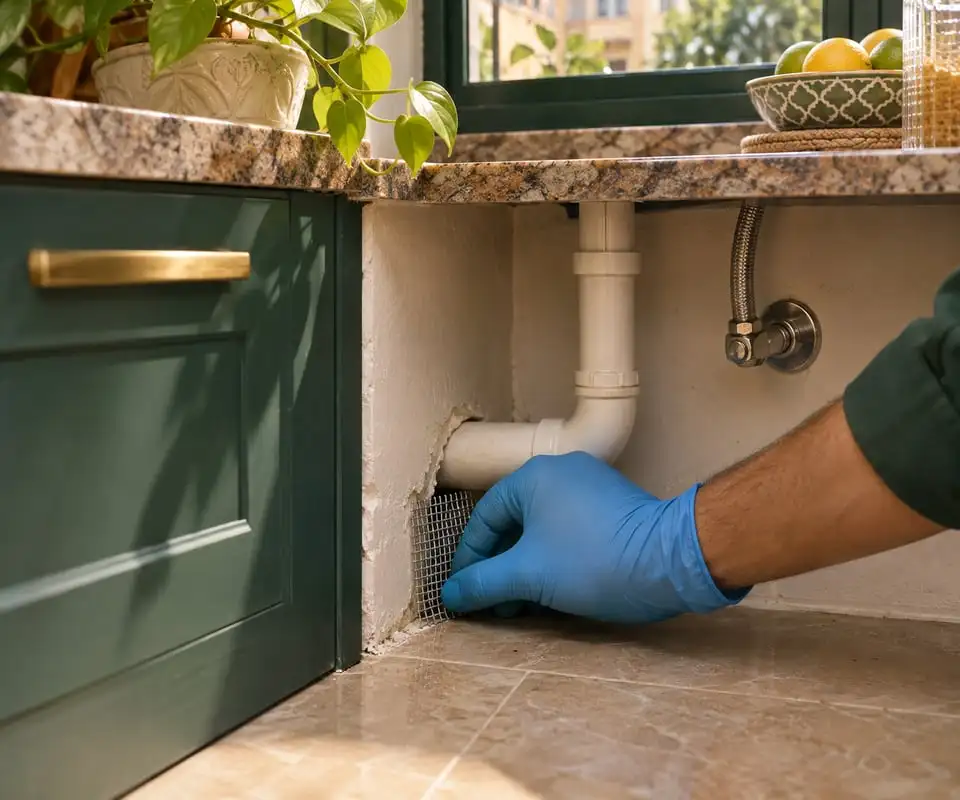
- 2Sealing gaps, ventilation shafts, and the areas around pipes
- 3Secured bait stations out of reach of children and pets
- 4Securing garden stores, service rooms, and the villa perimeter
- 5Sanitizing areas where droppings were found
See the work for yourself
Rodent control starts with one question: where does the mouse get through?
Mice like to run tight against the wall and take the same route every night, so the route can be read if you know what to look for. We follow the droppings, gnaw marks, and greasy lines from the first place you saw a sign until we reach the opening. We start with these spots:
- Behind kitchen units and under the sink, at the drain pipe and the washing machine hose
- The front door threshold if there is a gap under it, and the door to the ventilation shaft
- Gypsum ceilings, a quiet route nobody looks into
- The stairwell and the meter room in the building
- In villas: the garden pump room, the garage, and piles of old wood
A small mouse or a big rat? The difference changes the plan
A small mouse is curious, eats small bits from many spots close together, and leaves small droppings. A big rat, the kind people call a sewer rat, is wary of anything new on its route. It can spend days circling a trap or bait before going near it, and its droppings are clearly larger. That is why we ask about the size of what you saw and look at the droppings before deciding where the stations go and how many we need. If you have a rat, do not worry if there is still movement in the first few days after the visit. That is expected, and the 10-day follow-up is there to check on it.
Mistakes that keep mice around longer
We have all tried one of these. Most give you a couple of quiet days while the problem stays where it is:
- Plugging the hole with foam or cloth alone. The mouse chews through it
- One glue trap in the middle of the room, away from the route it runs
- Open poison in the kitchen or on the stairs, which is dangerous for any child or cat
- Cat or dog food left out all night
- Old boxes and bags piled on the balcony or in the storeroom, a ready-made place for a nest
Kids, pets, and furnishings
Mice and rats are a health hazard in themselves, and bait has to be placed with care. We put it inside closed stations in specific spots, so ask the technician where they are before the visit ends. If you have a crawling baby, someone pregnant, anyone with asthma or allergies, or a pet at home, tell us before the visit so we can choose the right spots, and ask your doctor if you have concerns.
- Do not open or move a bait station. If a child or animal gets to the bait, go to the doctor or vet right away and call us so we can tell you what type it is
- If a mouse bites or scratches someone, wash the area well with soap and water and see a doctor the same day
- Do not sweep up droppings while they are dry. Put on gloves, wet them with disinfectant first, then wipe them up and throw them away in a sealed bag
How to prepare the place
- Take photos of the droppings and gnaw marks before you clean them, because their shape tells us the type of rodent
- Tell us the last place you heard the sound, and at what time of night
- Empty the cabinet under the sink so we can reach the drain pipe
- Starting today, keep food and pet food in closed containers and do not leave water uncovered
Guarantee certificate
3
years
The guarantee covers the pests treated during the visit. If the same problem comes back within this period, we come and treat it.
Follow-up schedule
- 10 daysFollow-up visit to confirm the result
- 21 daysSecond follow-up to treat anything still open
- Every 2 monthsRegular follow-up for the length of the guarantee
Emergency service if any problem comes back during the guarantee
A guarantee with a schedulebeats a longer guarantee
Some companies promise 5 years and others promise 10. The question to ask is: what happens after the technician leaves?
Our answer is in writing. Three follow-up visits on set dates, plus emergency service if a problem appears at any time during the guarantee. The visit after 10 days is not a formality. That is when bed bug eggs hatch, and if it passes without treatment, the infestation comes back.
Questions about rodents
How long does it take to get rid of mice?
There is no fixed number, and it usually does not end in one day. The entry points have to be sealed first, and a wary rodent can take days to go near the bait. We come back after 10 days to check the stations and openings, after 21 days to confirm the movement has stopped, then every two months for the length of the guarantee.
Can a mouse die inside the wall and cause a smell?
It can, and anyone who says it is impossible is not being straight with you. We lower the chance by placing stations along the mouse's route, away from closed-off spaces as much as possible. If a smell shows up in a particular spot, call us. We will try to find its source and tell you how to deal with it.
I have a cat. Is that not enough to get rid of the mice?
Usually not. A cat may catch a small mouse, but mice move through places it cannot reach, like inside the ceiling and behind the units. The way in also stays open for others. We need to know about a cat in the home, so mention it on the call and we can decide where to put the stations.
Do mice really spread disease?
Yes, they can. Their urine and droppings can contaminate food and surfaces with infections like salmonella and leptospirosis. Throw out any chewed food, and wash any surface they walked on before preparing food. If someone at home gets a fever or severe muscle pain, tell the doctor you have mice.
Can mice come back after treatment?
They can if an entry point stays open or the building has a food source nearby, and that is what the two-month follow-ups look for. The 3-year guarantee covers mice if we treated them at your place. So if the scratching returns or you find new droppings, call us and tell us exactly where so we can start from there.
Can I call you at night if I can hear the mouse right now?
Yes. Our service runs 24 hours, we cover all 27 governorates of Egypt from our base in Fifth Settlement, and the visit time is set on the call. Until we arrive, keep food in closed containers, close the kitchen door at night, and do not put out open poison anywhere.
We come to any governorate, 24 hours a day
We are based in Fifth Settlement and serve all 27 governorates of Egypt. See the areas
Related services
Also: Bed bugs, Ants, Termites and wood borers, Mosquitoes, Fleas, Ticks, Geckos