
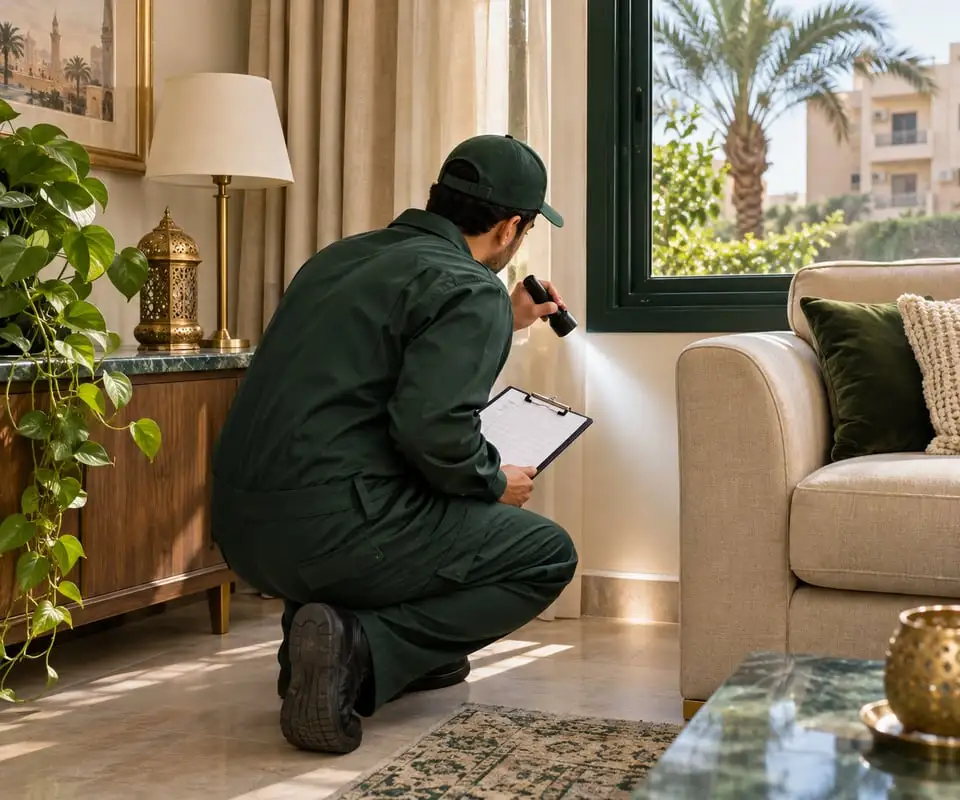
Choose a pest control company by four things you can check yourself: a valid Ministry of Health license, an inspection or detailed questions before a price is set, the name of the active ingredient and its label before any spraying, and a written guarantee that says what it covers and when the follow-ups happen. If a company fails any one of these four, look for another, even if its price is lower.
We are a pest control company, so this article comes from an interested party, and you should read it with that in mind. That is why we built it on the Ministry of Health’s statement and the regulations of the Egyptian Drug Authority, along with sources from the US Environmental Protection Agency (EPA), the World Health Organization, and American universities. All of them are listed at the end of the article. You can put every question here to us, the same as anyone else.
What is the best pest control company in Egypt?
We did not find any official body that ranks pest control companies in Egypt, so any “top 10 companies” list is the opinion of whoever wrote it, and sometimes it is an ad. The best company for you is a licensed one that can answer questions about your problem.
Search a little for “best pest control companies in Egypt,” or for a spraying or extermination company in your area, and you will find several calling themselves “number 1” or “the first.” That phrase tells you nothing you can verify. NPIC, the US pesticide information center, advises plainly against relying on advertising to judge any company’s reputation.
The most useful advice comes from the EPA: do not ask the company’s salesperson about its reputation. Look into it yourself. Talk to a neighbor or relative who has used the company, and ask specific questions:
- What was the pest, and did it come back? After how long?
- Did the technician inspect first, or start spraying right away?
- When you called after the visit, did anyone answer?
- Did the company honor the guarantee when you needed it?
Reviews on map listings and Facebook work as a rough indicator. Read the bad comments in particular and see how the company replied, because a pile of stars with no useful words may not tell you much.
“Best” also changes with the pest. A company that is good with cockroaches may have little experience with termites. So ask directly: have you worked on this problem before, in a place like my home? NPIC lists that question among its experience criteria and adds another: does a new technician train alongside someone experienced?
Check the license before anything else
In September 2026, the Ministry of Health and Population asked citizens not to deal with any insect and rodent control company before confirming that it holds a valid official license from the ministry. This is the first filter, and if a company fails it, there is no reason to ask the rest of the questions.
According to the statement as published by Youm7 and Masrawy, the ministry has identified entities operating through social media with no declared headquarters and no warehouses subject to inspection, and they may use pesticides of unknown origin. El Watan quoted the ministry’s spokesperson as saying the number of licensed companies at the time was 163 nationwide and that the list gets updated.
How to check in 5 minutes
- Ask for the company’s full name as written on the license, not the name in the ad.
- Compare that name with the ministry’s list of licensed companies. Masrawy reported that the list was available through a link and a QR code with the statement, and the ministry also refers people to its official website.
- Confirm the license is still valid and did not expire a while ago.
- When the technician arrives, ask to see the original license before work starts. The ministry itself asks for this, so there is nothing awkward about the request.
- If the company gets annoyed by the question or talks around it, treat that as your answer.
If you find a fake entity or someone using unknown materials, report it to the Ministry of Health’s channels or the Consumer Protection Agency. El Watan also reported that complaints about service quality at a licensed company go to the Consumer Protection Agency.
Why the name matters so much
You will find plenty of companies with the word “German” or “Germany” in their name, and we are one of them. That word gives you nothing to base a decision on, so rely on the full legal name. Match the name on the license, the name on the contract or invoice, and the name behind the number you are calling. If the three do not match, ask why before you pay.
The product has its own regulator
The Egyptian Drug Authority has a department for registering disinfectants and insecticides. Its regulations separate two types: ready-to-use household pesticides, and public health pesticides used only by specialists, such as pest control companies and the Ministry of Health’s pest control department. They also require the active ingredient to be listed in the World Health Organization’s scientific reference for the target pest.
According to El Watan, the ministry says you have the right to ask about the product’s source, registration, concentration, dilution, and storage, and to refuse any container of unknown origin or composition. So the questions below are not you being fussy.
Questions to ask before you pay
A serious company will answer these without getting irritated, and it may put most of the answers in writing. The EPA says any company, even one advertising itself as “green,” should inspect the site and offer a plan covering the pest, the size of the problem, the active ingredient, the application method, and the instructions you need to follow.
1. What will you inspect before spraying?
Ask them to name specific spots. For bed bugs: mattress seams and cracks in the bed frame. For cockroaches: inside kitchen units, behind the fridge, and around the floor drain. For mice: openings, drain pipes, and movement paths.
An answer like “we will just spray the whole apartment” means they have not seen the problem yet. If the service covers several pests, like a complete program for all pests, the inspection has to cover inside and outside, because each pest has its own place.
2. What insect is this, and how far has it spread?
NPIC says the employee should be able to identify the pest and explain the size of the infestation and how the insect behaves. If someone tells you “those are just regular bugs,” nothing has been identified. The treatment depends on the pest: spraying has nothing to do with mice, random spraying can split a pharaoh ant colony into smaller colonies, and termites do their work inside the wood.
3. What is the active ingredient? Can I see the container and its label?
Ask for the scientific name of the active ingredient, not just the brand name. Photograph the container and the label before it is opened. The EPA says reputable companies can give you product labels and application rates, and it advises asking for the safety data sheet too.
The active ingredient is printed on the container, so there is no reason to hide it. The EPA and the University of Nebraska both treat talk of a “secret formula” as a warning sign. The same goes for “German serum” and “imported material” with no name attached. You have the right to know the product’s name from any company, including us.
4. How will you apply it, and exactly where?
Gel in cracks is different from spray on a floor, and bait in a closed station is different from poison tossed under a wardrobe. The EPA tells you to ask about baits and crack treatment where they fit, and it warns against spraying pesticide across a whole room. Ask the technician this as well: is there a non-chemical solution that would work here?
The World Health Organization says to choose the least hazardous option if a pesticide is necessary, and the EPA says to ask for the least toxic method that will do the job.
5. How many visits, when, and why that number?
Ask for specific dates and the reason for each visit. With bed bugs, for example, eggs hatch in about a week, so a single visit with no follow-up makes little sense. Also ask what happens on the second visit: inspection only, or treatment too? The EPA says pesticide should be applied when the pest is really there, and that a home service contract should include periodic inspection.
6. What do I need to do before and after spraying?
You want a specific answer: what to empty, what to cover, when children and pets can come back, and when to mop the floor. Say early on if the home has a baby, a pregnant woman, an older person, or someone with asthma or allergies. The EPA says these concerns should go into choosing the product itself, not come up after the work is done.
7. If something gets damaged, who pays?
The EPA and NPIC treat damage insurance as an important criterion in the US. We have no confirmed information on how common it is among companies in Egypt, but the question still works: if a product stains a sofa or ruins marble, who pays for it? Get the answer in writing.
8. Will you look for the cause of the problem?
The EPA says to ask the technician to find the source and fix it before spraying, such as a water leak. That makes sense. As long as there is standing water, mosquitoes will breed, and if a pipe opening is left open, mice will get in. A good technician will tell you what you need to do on your side too, even if that brings no extra work.
9. What does the guarantee cover, and what cancels it?
Ask to read it before you pay, not receive it afterward. The guarantee section below goes through the items to look for, one by one.
10. What exactly does the price include?
Ask about the number of visits, the follow-ups, an emergency visit if the pest comes back, and any cost that might be added. If the number can change after the inspection, find out what would change it.
Reassuring answers and worrying answers
The same question can be answered two ways, and the difference shows you how the company works. You can keep this table open while you are on the phone with them.
| Question | Reassuring answer | Worrying answer |
|---|---|---|
| Are you licensed? | Here is the company name and license number, and you can check it | Everyone knows us, we do not need that |
| What will you inspect? | Names specific spots based on the pest | We will spray everything |
| What is the product? | Names the active ingredient and shows you the container | It is our own special formula |
| How many visits? | A number, dates, and a reason | One spray and you are done |
| Is it safe for my child? | Asks about the child’s age and health, and gives you instructions | 100% safe, do not worry |
| What is in the guarantee? | States what is covered, what is excluded, and the follow-up dates | Lifetime guarantee, call us if anything happens |
| How much is it? | Asks about the area, the pest, and the size of the problem | An instant number with no questions |
The guarantee: how to read and compare it
More years on a guarantee is not always better. Its value is in what is written in it: what it covers, what cancels it, and who comes when. And after all that, the EPA says a guarantee is only worth as much as the company giving it.
You will see ads saying “5-year guarantee,” and some of them add “on some services.” Read those words carefully. Ask: is my service included? Is my pest included?
Let’s be upfront here. Our guarantee is 3 years, so this argument serves us, and you should naturally take it with caution. A 5-year guarantee with a clear follow-up schedule and written terms is stronger than 3 years on the same terms. What we warn against is the guarantee with a big name and no details, like this example:
| Point of comparison | Long guarantee with no details | Shorter guarantee with a schedule |
|---|---|---|
| Length | A big number in the ad | A smaller number, in writing |
| After the technician leaves | If there is a problem, call | Follow-up visits with dates |
| Who moves first | You have to complain and prove it | The company has a set date to come back |
| Coverage | “All insects,” said verbally | The treated pests, by name |
| When there is a dispute | Your word against theirs | Paper you can go back to |
A guarantee with no dates leaves all the work to you. And if the eggs hatch a week later, nobody is going to come check on their own.
7 things you should find in writing
- The company’s name as on the license, its address, and a contact method that really gets answered.
- The covered pests by name, and the places treated.
- The start and end dates.
- The follow-up dates, and whether they carry a fee. The EPA notes that termite guarantees sometimes come with annual inspection fees.
- Retreatment if the pest comes back: within how many days, and at extra cost or not? The University of Nebraska tells you to ask about this in particular.
- What cancels the guarantee.
- What you have to do to keep the guarantee active.
Take that last point seriously
The EPA says to check what you have to do on your side, and it gives an example: a termite guarantee can lapse if you make changes to the house without telling the company. In homes here, think of things like a kitchen renovation, replacing woodwork, spraying pesticide yourself between visits, or refusing a follow-up visit. Ask about each one and get the answer in writing.
Also ask about the difference between a pest that came back and a new pest. If you were treated for cockroaches and ants show up, the guarantee probably will not cover them. That is not cheating, but you need to know it from the start.
Pest control company prices: what sets the number?
There is no single correct price for pest control, because it depends on the area, the type of pest, the size of the infestation, and the number of visits. We are leaving numbers out of this article on purpose. You will find widely different figures online because they are not pricing the same work, and no number in an article will be the number for your home.
These are the factors to expect any serious company to ask about:
- Size and layout: an apartment is different from a villa with a garden, and a ground floor is different from a high floor.
- Type of pest: bed bug treatment targets seams, joints, and eggs, and termites need injection into the wood, which is very different from cockroach gel in a kitchen.
- Size of the infestation: one room where it started recently is different from a whole home with an old infestation.
- Number of visits and follow-ups: a price with one visit cannot be compared with a price that includes a follow-up schedule.
- Guarantee: its length and terms are part of what you are paying for.
- Building and neighbors: if the infestation comes from shared pipes or the apartment next door, the plan changes.
How to compare 3 quotes
The EPA and Nebraska both recommend two or three quotes, compared on value and not just price. NPIC advises asking for the quote in writing. Most pest problems, according to the EPA, can wait a few days while you compare, so do not act under the pressure of “the offer ends today.” The exception is a case like a snake in the house: call a specialist immediately and stay away from it.
Write the quotes side by side like this, and ask about any empty cell:
| Item | Company 1 | Company 2 | Company 3 |
|---|---|---|---|
| Licensed and on the ministry’s list | |||
| Inspection before the final price | |||
| Active ingredient and application method | |||
| Number of visits and their dates | |||
| Guarantee length and coverage | |||
| Retreatment cost | |||
| Total amount |
The University of Nebraska warns about big gaps between quotes and says the lowest quote is not always the best value. If one quote is far from the others, cheaper or more expensive, ask what they are doing less or more of. The answer may convince you, or the difference may turn out to be the product’s concentration or the number of visits.
As for getting a “pest control price” over the phone: it is fine for a company to give a rough estimate after asking how many square meters, which insect, and since when. The problem is a number that comes before any question, or a final price that changes when the technician arrives with no clear reason. Ask from the start what could change the number.
Signs you should look for another company
If more than one of these shows up, save your time and money. Most of this list appears in guidance from the EPA and the University of Nebraska, and we applied it to what you see in the market here.
- A final number over the phone without one question about the place or the pest.
- A verbal guarantee, or a paper with only the word “guarantee” and a duration.
- “One spray and you are done” for every kind of insect. Bed bug eggs hatch after spraying, and cockroaches avoid sprayed surfaces and hide deeper.
- A discount on condition that you decide now. The EPA lists a discount for immediate treatment among its warning signs.
- Refusing to name the product, or the “secret formula” excuse.
- A container with no label, a container with the print wiped off, or liquid in a jerrycan with no details on it.
- A Facebook page with no address, no number that answers, and no legal name.
- A salesperson who knocks without an appointment and says your neighbors have an infestation, or shows you insects supposedly from their place. The EPA mentions this exact tactic.
- Scare talk like “your house will fall down” to get you to sign today. The EPA warned about this tactic too.
- Full payment up front before any work. Nebraska says not to pay in advance on termite contracts, and the idea makes sense for any large service.
- Talk of “100% safe” or “not chemical at all” with no instructions.
50% off what?
A discount is not a flaw in itself, and any company can run an offer. But a percentage of a number you do not know means nothing. If an ad says 50% off and nobody has told you the price before it or the service after it, you do not know what you are saving. Ask: what is the final price after the discount, and how many visits does it include? Ask too: do the guarantee and the follow-up stay the same after the discount? Then compare the final number with the work in writing, and forget the percentage.
What does “safe” mean?
NPIC tells pest control companies themselves that any pesticide is toxic if the exposure is large enough, so no pesticide is completely safe, and it is more accurate to talk about levels of risk. It explains this with a simple formula: toxicity times exposure equals risk. The word “safe” on its own can be taken to mean you need no precautions, and that is the wrong takeaway.
So when you hear “safe” from any company, answer with a question: safe under what conditions? When do I come back? What do I move away? If someone at home has asthma, what changes? A company with answers will give them. Having no smell is a comfort, but it does not measure how safe the product is.
What to do on the day of the visit and after
Choosing does not end with paying. The EPA says your work is not finished yet, and that you need to evaluate the result and keep asking until the problem is solved.
Before the technician starts
- Ask the technician’s name, confirm they are from the company you agreed with, and see the license.
- Photograph the container and the label, and write down the product’s name.
- Empty whatever they asked you to empty. The EPA mentions floors and kitchen cabinets if they request it.
- Keep children and pets away. The World Health Organization says people present during spraying are at higher risk, so keep them out of the space during spraying and right after.
- If you have a fish tank, cover it with a thick plastic cover and turn off the air pump, or move it, as the EPA recommends.
While the technician works
The University of Nebraska advises being present, watching, and asking questions, at least for termite work. Do not feel shy. Is the technician really inspecting first? Wearing protection when needed? NPIC treats that as a safety criterion. Reaching the places they said they would?
After the technician leaves
NPIC advises keeping a record with the company’s name and the technicians’ names, the inspection and treatment dates, the products and where they were used, and the precautions. It will help if you need to claim on the guarantee, and it will help the doctor if someone gets sick.
If anyone at home feels skin or eye irritation or shortness of breath, leave the place and take a photo of the container with you. El Watan quoted the Ministry of Health as saying these symptoms can occur with unknown products or wrong concentrations, that children, older people, and people with allergies or asthma can be affected more, and that you can go to a poison center or call 137. If the shortness of breath is severe, go straight to the emergency room.
Checklist before you pay
A company that gets a “yes” from you on all of these items is one whose price you can compare with confidence. The items are in order, and a company that fails the first one does not move on.
- The company’s legal name is on the Ministry of Health’s list, and the license is valid.
- I saw the original license, or we agreed the technician will bring it.
- The company asked me about the place and the pest before giving a number.
- I know exactly where they will inspect.
- I know the name of the active ingredient, and I will see the container and its label before spraying.
- I know the application method (spraying, gel, bait, fogging, or injection) and where.
- I have clear instructions for before and after spraying, and I told them who is in the home.
- The number of visits and their dates are in writing.
- The guarantee is in writing: pests, length, follow-up, what cancels it, and retreatment cost.
- The final price is in writing, and I know what could change it.
- I have a contact method that gets answered and an address I can reach.
- Nobody is pressuring me to decide today.
How Kaltex answers these questions
This is what we can say about ourselves, and you have the right to ask for the guarantee in writing.
In the complete program we start by inspecting the apartment or villa inside and out, and we make a plan for each pest based on its nature, because one spray with the same product is weak against all of them. With bed bugs, we locate the infestation sites and eggs before treatment. With cockroaches, we use gel at gathering points instead of random spraying. With mice, we trace movement paths and seal entry points.
Our guarantee is 3 years and covers the pests treated in the visit. So if a different pest shows up that was not treated, it is not included. The follow-up schedule is after 10 days, after 21 days, and then every two months for the length of the guarantee. If the same problem appears during that period, we have an emergency service and we come treat it. The 10-day visit is deliberate, because bed bug eggs hatch in about a week.
We work with European materials, our spraying and fogging are odorless, and in most cases you will not have to leave your home. Ask the technician the same questions above about the product’s name and the instructions for your situation, and say who is at home. If you have a baby, a pregnant woman, or someone with asthma at home, ask the doctor too before any chemical treatment.
We are based in Fifth Settlement, we serve all 27 governorates of Egypt, and the service runs 24 hours a day. We will not tell you we are the best. Ask us these questions, and compare our answers with any other company’s.
Frequently asked questions about choosing a pest control company
What is the best home pest spraying company in Egypt?
We found no official ranking, so there is no single right answer for every home. Choose a company that is on the Ministry of Health’s list, inspects before it sprays, tells you the product’s name, and gives you a written guarantee with dates. If two companies pass all of that, compare them on service and price.
What do pest spraying companies in Egypt charge?
You will not find a number that fits every case, because the price depends on the area, the type of pest, the size of the infestation, and the number of visits. Get two or three written quotes for the same work, and compare the totals along with what each one includes.
How much does it cost to spray an apartment for bed bugs?
It varies with the number of infested rooms, the furniture, and the number of visits. Bed bugs in particular need follow-up because of the eggs, so if a cheap quote has one visit, you may end up paying twice. Read our bed bug guide so you know what to ask before you agree.
Does “German” in a company’s name mean it is foreign or better?
The name alone proves nothing, because “German” or “Germany” appears in many company names, including ours. Check the legal name on the license and on the ministry’s list, then decide based on the work and the guarantee.
Is a 5-year guarantee better than a 3-year guarantee?
It can be, if its terms and follow-up are written just as clearly or more clearly. Before comparing the length, compare what it covers, who comes back when, and what cancels it. And if the company will not stick around or does not answer, the length will do nothing for you.
Can I buy an agricultural pesticide and spray it at home?
No, do not do that. The EPA warns against using products meant for outdoors inside the home, because they can stay toxic longer. The Egyptian Drug Authority also designates public health pesticides for specialists. If you are buying something yourself, choose a household product that names your insect on the label, follow the label to the letter, and do not increase the dose.
Is there a number that sprays homes for free?
We found no official source for a service like this for homes, so we cannot confirm it. If someone offers free spraying and then asks for money, or talks to you as if they represent a government body, ask for proof and check with the Ministry of Health’s channels.
Do I have to leave the house during spraying?
It depends on the product, the application method, and the health of the people at home, and the product label and the technician’s instructions decide that. The World Health Organization says to stay away during spraying and right after, and the EPA says children and pets should stay away until the spray dries. Ask before the technician comes, not while they are standing at the door.
The technician shows up with no container, or with one that has nothing written on it. What do I do?
Stop the work and call the company. El Watan quoted the Ministry of Health as saying you have the right to refuse any container of unknown origin or composition, and that is the simplest reason to say no, even if you have already paid.
If the insects come back after spraying, is the company a scam?
Not necessarily. Some pests normally show up days after treatment, like bed bugs hatching from eggs, and an infestation can also come from neighbors. That is exactly why a follow-up schedule exists. Look at how the company responds: did it come, inspect, and treat under the guarantee, or did it disappear?
Sources
- Youm7: Ministry of Health warns against unlicensed pest control companies
- Masrawy: Health ministry warns against unlicensed companies and publishes the approved list
- El Watan: Health ministry warns against unlicensed pest control companies
- Egyptian Drug Authority: Regulations and procedures for registering insecticides
- EPA: Choosing a pest control company
- EPA: Tips for selecting a pest control service
- EPA: Dos and don'ts in pest control
- NPIC, Oregon State University: How to choose a pest control company
- NPIC: Is this pesticide safe?
- University of Nebraska-Lincoln: Choosing a pest control company
- World Health Organization: Questions and answers on pesticide safety