
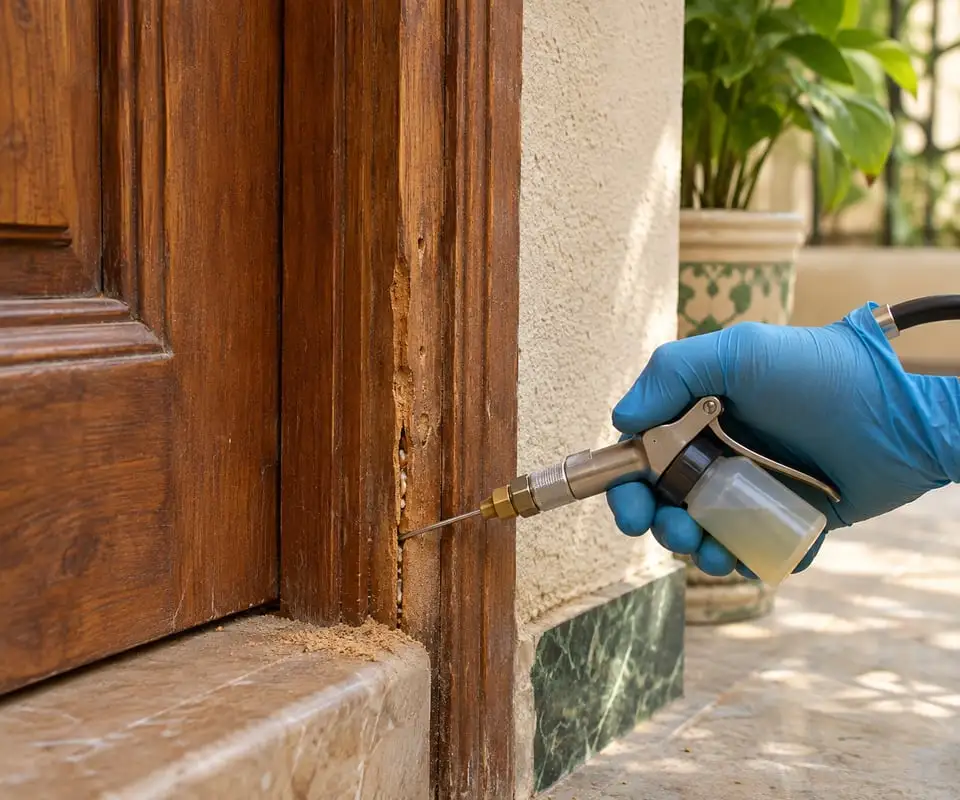
If you find dried mud running up a wall, or tiny pellets under a door frame, you most likely have termites. If you find small round holes in the wood with powder as fine as flour beneath them, you most likely have wood borers. That difference decides the treatment: termites are a colony you have to reach, and wood borers are beetle larvae living inside the piece of wood itself.
The good news is that you have time to make sure. The University of Kentucky says termites damage wood slowly, and that waiting a day, a week, or a month to choose a good company usually won’t make much difference. It says the same about damage from wood beetles. So don’t sign a contract under pressure, and don’t panic and pour kerosene on the wood. Just don’t leave it for months without an inspection either, especially if that wood is holding something up.
In a hurry? Jump to “How to inspect your home yourself.”
The difference between termites and wood borers
Termites are social insects that live in a colony. They eat wood from the inside and leave mud or pellets behind. “Wood borer” is the everyday name for small beetles whose larvae do the tunneling, and what they leave is round holes and powder. This table will settle most cases.
| Comparison | Termites | Wood borers |
|---|---|---|
| The insect | A colony with workers, soldiers, and winged termites | Small beetles, with the larva inside the wood |
| What you see | Mud tubes, hard pellets, or wings | Round holes and powder |
| Inside the wood | Tunnels along the grain with mud in them, or smooth tunnels with pellets | Small tunnels packed with powder |
| The insect itself | Workers stay hidden, and winged termites come out in certain seasons | Adults are rarely seen |
| Moisture | The underground type needs a lot of it | Some types tolerate dry wood, and others need damp wood |
| Where treatment starts | Identify the type and reach the colony and its paths | Confirm it’s active, then identify the type and the affected piece |
In Egypt, people use the word “soos” for a lot of things: a beetle in the wardrobe, the weevils in fava beans and rice, even termites themselves. So go by the evidence in front of you, not the name the carpenter or the neighbor gave it.
What termites look like
A termite’s appearance depends on its job in the colony. A worker is soft and pale, a soldier has a big dark head, and a winged termite looks a lot like a flying ant. If you break open a piece of infested wood, workers are what you’ll most likely see.
| Colony member | Appearance | Where you’ll find it |
|---|---|---|
| Worker | Soft and wingless, cream or light caramel in color | Inside wood and tubes |
| Soldier | Large amber or brown head with big jaws | Inside tubes and infested wood |
| Winged termite | 2 wings on each side, all the same length, with color that varies by species | Around windows and lights during flight |
These descriptions and colors come from American sources, and Egyptian species may differ in the details. The differences from regular ants hold, though.
| Sign | Termite | Regular flying ant |
|---|---|---|
| Antenna | Straight, and may droop | Bent like an elbow |
| Midsection | Thick, with no waist | Clearly narrow waist |
| Wings | Front and back the same length | Front longer than back |
Found flying ants in the house? What to do
Sweep or vacuum them up, and photograph a few first. The winged ones don’t damage wood themselves. The University of Kentucky says they live about 1 day indoors and head toward light, which is why you find them at windows. What matters is where they came from.
If they came out of a tree stump or a woodpile in the garden, that’s no proof the house is infested. But if they appear inside the house, or are coming up next to the building’s foundation, take it seriously: the same university says their presence indoors usually means an infestation that needs treatment. Shed wings on a windowsill mean the same thing, even if the insects themselves are gone.
Types of termites: subterranean and drywood
The 2 types worth knowing are the one that lives in soil and the one that lives inside dry wood with no soil at all. Their treatments are very different. The University of California says methods like fogging the whole building (fumigation) and heat apply to drywood termites and don’t work on subterranean ones, because most of the colony is in the soil.
| Comparison | Subterranean | Drywood |
|---|---|---|
| Nest | In or near the soil | Inside the piece of wood itself |
| Best-known sign | Mud tubes about the width of a pencil | Hard pellets under holes smaller than 2 mm |
| Feeding pattern | Along the grain in layers, with soil in it | Smooth and in any direction, with pellets in it |
| Colony size (California) | Can reach hundreds of thousands | Usually fewer than 1000 |
| Does it reach furniture? | Through mud, if there’s a way | Can live in furniture and move with it |
| Moisture | A basic requirement | Gets water from the wood itself |
Drywood pellets are a strong sign. They’re about 0.8 mm long and have 6 sides if you look through a magnifying glass, as Texas A&M University describes them. Their color is close to the wood’s, so you might mistake them for sawdust.
Which species are in Egypt?
An old survey from Ain Shams University, published in 1973, found 4 species. The 2 most dangerous and widespread were Anacanthotermes ochraceus, the best known in Lower Egypt, which had reached Borg El Arab and Matrouh, and Psammotermes hybostoma, a sand-loving species found mainly in Upper Egypt, on the desert fringes, and in the oases. The study focused on the countryside, especially mud brick houses.
In a survey published in 2005 on the Bahariya Oasis, which belongs to Giza, researchers inspected 6600 buildings and found 2150 of them infested with these 2 species, or 32.57%. The sand species turned up in door and window frames, cardboard, and paper, and even in wheat, dried dates, and stored bread. That figure applies only to that area, and you can’t generalize it to all of Egypt.
In Alexandria, Asharq Al-Awsat reported in 2019 that the head of the termite control center at Alexandria University said his study found infestation by the subterranean type reaching 90% in Smouha between 2003 and 2005. He also said the type that eats dry wood and furniture reached 60% there and 40% in the rest of the city. The newspaper did not name the species, or say exactly 60% of what.
So, to be straight with you: no source we opened offers a current map of all species in every governorate. Most of the behavior and timing details in this article also come from American universities, so treat them as a general guide and not a guaranteed rule for Egypt. Identifying the species in your home takes examining a sample.
What wood borers look like, and their types
The wood borers that infest homes are small beetles, reddish brown to dark. The common types are usually 1.6 to 6.4 mm long, and you’ll rarely see one anyway. The larva lives and tunnels inside the wood, and the adult exits through a round hole and leaves. So what you’ll recognize is the hole and the powder.
These groups come from American classification, but they help you read the evidence. Try the University of California’s “pen test”: put the tip of a retractable ballpoint pen in the hole, and rub a little powder between your fingers.
| Group | Hole | Powder | Wood | Ballpoint pen |
|---|---|---|---|---|
| Powderpost beetles (Lyctus) | Pinhead size | Like flour or talc | Hardwoods and bamboo, such as oak and walnut | Only the tip goes in |
| Furniture beetles (Anobiidae) | 1.6 to 3 mm | Slightly gritty | Hard and soft wood, including beams and joists | The tip and part of the pen’s cone go in |
| Bostrichids (Bostrichidae) | 3 to 6 mm | Coarse and packed into the hole | Usually hardwood | The whole tip goes in |
The difference changes the plan. Powderpost beetles need starch in the wood, so the infestation usually dies out on its own as the wood ages, though they may keep emerging for about 5 years. Bostrichids rarely come back after the first generation. Furniture beetles digest cellulose itself, so they infest wood of any age and return year after year, especially in damp places. They’re the ones that can damage a load-bearing part of a home over the long term.
One generation takes 3 months to more than a year in powderpost beetles and about 2 years in furniture beetles, and the University of Kentucky says the adult can emerge 1 to 5 years after the egg is laid. So you might buy a sofa or install a door today, see holes a few years later, and blame the neighbors when the borers were in the wood from the start.
Signs of termites and wood borers in the home
The strongest termite signs are mud tubes, hard pellets, and wood that’s hollow inside. The strongest wood borer signs are round holes with fresh powder beneath them. Any one of these alone is enough reason to inspect, but not enough to reach a verdict.
| What you found | What it probably is | Next step |
|---|---|---|
| A mud tube on a wall or baseboard | Subterranean termites | Break off a small piece and look inside |
| Hard pellets like fine sand under the wood | Drywood termites | Clean the spot and watch it for a few days |
| Round holes and fine powder | Wood borers | Mark the holes and check them again |
| Equal-length wings at a window | Winged termites | Photograph them and inspect nearby wood |
| Bulging or rippled wallpaper | Possibly termites, possibly moisture | Inspect the wall and the wood behind it |
| Small holes in plaster with mud around them | Termites | Inspect and look for nearby tubes |
| Wood a screwdriver sinks into easily | Termites or rot | Look at what’s inside: mud, pellets, or crumbling fibers |
| Musty smell and swollen wood | Moisture, possibly termites | Look for the leak first |
A faint sound inside the wood may make you suspicious, but treat it as a reason to inspect, not as proof on its own. Seeing no signs at all is also possible: the University of Kentucky says many infestations go for years without clear signs.
Things people mistake for termites and wood borers
Damp wood can be rotting with no insect involved. NC State University explains that brown rot makes wood dark and cracked and crumbles it to powder, while white rot makes it pale and spongy. Wood rots at about 30% moisture, and the fungus stops below 20%. Here the main fix is repairing the moisture problem and the wood. Pesticide won’t do it.
There’s also a very small beetle (foreign grain beetle) that eats mold and leaves the wood alone, so it’s a sign of moisture and doesn’t need the same treatment. Sawdust falling from a new piece or after carpentry work is normal and has nothing to do with wood borers. Firewood brought in from outside can produce forest beetles, but the University of California says they don’t infest the wood used in a home.
How to inspect your home yourself
An inspection at home will tell you whether there’s reason to worry and which pest it looks closer to. Get a strong flashlight, a flathead screwdriver, a sheet of white paper, and a phone for photos, and start with damp areas before the big rooms. El Watan reported in 2022 that infestations often start in bathroom and kitchen wood, such as doors.
- Don’t start by spraying pesticide. Spraying hides the evidence the technician needs to see, and it can drive the insect away from the spot you’re inspecting.
- Go around the bottoms of door and window frames, at the point where they touch the wall or floor.
- Check the backs of wardrobes and bookcases placed against a wall, the baseboards and parquet, and any storeroom with cardboard boxes.
- With the screwdriver, press gently into any wood that looks different. The EPA recommends this to find hollow spots, and the University of California explains that infested wood has a thin surface that punctures easily.
- If you find a mud tube, break off a small piece and look inside. If soft, pale insects come out, the infestation is active.
- If you find pellets or powder, put some on the white paper and photograph it next to a ruler or a coin. Rub it between your fingers: powder goes smooth, and pellets stay pellets.
- Try the pen test on the holes if you suspect wood borers.
- Look for a leak or moisture around every spot where you found evidence, and write it down.
If it involves a wooden ceiling, an exposed beam, or a spot with electrical wiring, don’t break or open anything yourself. Take a photo from a distance and call a specialist.
How to tell if an infestation is active or old
The easy test is to clean off the evidence and wait. Fresh powder is the color of freshly sawn wood, and the hole has a clean edge. Old powder turns yellowish and clumpy, and the hole looks faded.
| Sign | What to do | What it means |
|---|---|---|
| Holes and powder | Sweep up the powder, seal or mark the holes, and recheck after a while, preferably in spring and summer | New holes or fresh powder mean an active infestation |
| Drywood pellets | Clean them up well and recheck after a few days | New pellets suggest it’s active |
| Mud tube | Break off a piece and recheck after a few days | If it has been repaired or has workers in it, it’s active |
This test isn’t conclusive in every case. Shaking and vibration can knock down old powder or pellets, and an empty tube doesn’t mean the colony is gone, because termites abandon sections of tube and carry on by another route.
Why did termites suddenly show up in the house?
Most likely they didn’t come suddenly. The colony or larvae were already there, and the wings or powder are what made you notice. Sources such as the University of California tie the problem to moisture and wood close to the soil more than anything else.
- A water leak in a bathroom, kitchen, or AC unit, or a wall soaking up moisture from below.
- Wood touching the soil, or a threshold or frame that reaches the ground.
- Old cardboard, wood, and newspapers stored next to the foundation or under the stairs.
- Cracks in the foundation, or unsealed openings for pipes and wiring.
- Tree stumps and scrap wood buried around the building.
- Used furniture or wood that came into the home already infested. According to the University of Kentucky, this is the most common route for powderpost beetles.
- A closed-up apartment with parquet and a leak. El Watan reported that this is one of the most dangerous situations, and that the infestation can spread from it to neighboring apartments.
In Alexandria in particular, the head of the university’s center explained to Asharq Al-Awsat that Smouha’s clay soil and its old timber warehouses in the 1950s and 1960s prepared the area for colonies, and that many buildings in the 1970s and 1980s went up without soil treatment. So if you live there, this has nothing to do with how well you clean your home.
Can termites bring a house down? And when should you call an engineer?
In a sound concrete building, the bigger risk is usually to the wood and furniture inside, not to the steel and concrete. Houses built of wood or mud brick are in a harder position. And if the infested piece carries a load, you need an engineer along with the pest control company.
The head of the Alexandria University center said termites don’t eat the steel in concrete, so foundations aren’t their main target. They do damage bricks and old, deteriorated concrete, though, and their greatest threat is to the wood and furniture inside the building. The picture in the countryside can be worse. The old Egyptian survey recorded a village in Beheira that its people abandoned in 1930 because of infestation, and about 200 infested houses in a village in Fayoum, some of them abandoned.
NC State University makes an important point about wood beetles: you can’t tell from the look of a board alone whether the damage needs repair. A screwdriver only gives you an idea. The University of California says much the same about termites: if the wood carries a load, consult an architect, a structural engineer, or a contractor.
| What you have | Who to call |
|---|---|
| Holes in a chair, a picture frame, or a small piece | You may be able to treat or replace it yourself. If in doubt, call a company |
| A door, frame, or parquet with signs of damage | A pest control company, then a carpenter to replace what’s ruined |
| A frame that wobbles, a door that suddenly won’t close, or a sinking wood floor | A pest control company and a carpenter, plus an engineer’s opinion if the piece is carrying something |
| A wooden beam, ceiling, staircase, or column | A structural engineer first, and don’t put anything heavy on the spot until they’ve seen it |
| A mud brick house with cracks and mud tubes | An engineer and a pest control company together |
Know this from the start: any pest control, ours or anyone else’s, aims to stop the insect and won’t bring back the wood that’s been eaten. A weak piece stays weak until it’s replaced or reinforced.
The order matters too. El Watan passed along advice not to dispose of infested wood before treating it, so you don’t spread the infestation. And if you plan to paint or refinish parquet that had wood borers, the University of Kentucky advises waiting about 6 months, in case new holes appear.
Treating wood borers at home
If the infestation is in a small piece, you can treat it yourself: confirm it’s active, then freeze or replace it, and seal the surface with paint afterward. If it’s in joists, walls, or more than one place, that’s specialist work. No single spray is guaranteed to reach a larva deep in the piece.
- Wait and confirm. The University of Kentucky says the damage is slow and usually doesn’t call for a quick reaction if you aren’t sure it’s active. Mark the holes and check back.
- If the piece is small, put it in a sealed bag in a freezer at minus 18°C for 72 hours, according to the University of California. The University of Kentucky gives 3 to 7 days. Wood thicker than 5 cm needs longer. Use a thermometer, because not every freezer reaches that temperature.
- Anything that can’t be frozen can be treated with heat at 49 to 60°C for 6 hours, but that takes special equipment and won’t work with fabric, leather, or paint. Don’t put furniture in a home oven.
- If a board is clearly infested, replace it and the boards touching it, and dispose of the old ones safely. This works well with powderpost beetles and bostrichids.
- After treatment, paint or varnish exposed wood. Females lay eggs on bare wood, and paint seals the holes and pores.
- If the infestation is in damp wood, lower the moisture. Furniture beetles need wood moisture of 13 to 30%, and the University of Kentucky aims for below 14%. A wood moisture meter helps here.
Borates and fogging: when do they make sense?
Borate products soak into bare wood and don’t pass through paint or polyurethane. So they help more on unpainted structural wood than on dry, finished parquet, and below 15% moisture they may penetrate only a quarter inch. The University of California says a licensed specialist must apply them.
Fogging a whole building (fumigation) with a product like sulfuryl fluoride is expensive and a hassle. Residents leave the home for about 3 days, and it doesn’t prevent the infestation from coming back afterward. The University of Kentucky says it’s usually left for furniture beetles inside walls or between floors, and that fogging a single piece of furniture is cheaper and better. These methods aren’t all available in the same form in Egypt, so ask before you base a decision on them.
Termite control: the right treatment for each type
Termite control works when treatment reaches the colony and its paths, and when the moisture source gets fixed. If you spray only what you can see, you kill what the pesticide touched and the rest carry on. The EPA says plainly that products whose only job is to kill termites on contact don’t protect the building.
| Type | Methods the sources discuss | Limits |
|---|---|---|
| Subterranean | Chemical barrier in the soil around the building, injection into tubes and paths, slow baits | Treating only one spot is a gamble, per the University of Kentucky, and baits take months |
| Drywood, limited infestation | Injecting liquids or dust into the tunnels, or replacing the wood | Activity may return, because it’s hard to be sure you’ve found every colony |
| Drywood, widespread infestation | Fogging or heat for the whole building | No residual effect, and they need major preparation |
The numbers here show why this work is hard for one person. The University of Kentucky notes that soil treatment on an American house can use hundreds of gallons of liquid, injected along the foundation and under the floors. The University of California says outright that do-it-yourself termite products usually don’t work. What you can do yourself is fix the moisture and replace the wood.
The EPA also warns that many termite pesticides are highly toxic, and that misuse can contaminate the home and the water. So don’t buy a farm pesticide from a shop and spray it in the bedroom. If there’s a child, a pregnant woman, or someone with asthma in the home, ask the doctor and tell the technician before the work starts. And ask how long to stay away, since that varies by product.
Do the popular home remedies work?
You’ll find plenty of remedies online, and some are dangerous. Insects dying in front of you after spraying doesn’t prove the infestation is over, because the colony itself isn’t in front of you.
| Remedy | Verdict | Why |
|---|---|---|
| Kerosene, diesel, and gasoline | Dangerous, do not use | A scientific paper on wood treatment describes kerosene and diesel as toxic and a fire hazard. The smell also lingers inside the home |
| Spraying pesticide on the surface only | Temporary fix | Kills what it touches and doesn’t reach the colony or a larva inside the wood |
| Soapy water | Not a treatment | May kill an insect it touches directly, and that’s all it does |
| Boric acid and borates | Limited use | Borates soak into bare wood but won’t reach a colony in the soil |
| Orange oil and neem | Don’t rely on them | The University of California says tests from 2 universities cast doubt on d-limonene, the ingredient in orange oil |
| Wet cardboard trap | Can backfire | Cardboard and moisture are exactly the food and conditions termites look for near a home |
| Sealing holes with putty without treatment | Not enough | Reduces the chance of new eggs in the hole, but what’s inside carries on and will open new holes |
Kerosene deserves a closer look, because many websites still recommend it. A door or wardrobe soaked in kerosene in an apartment with a gas stove, a water heater, and cigarettes is a real fire hazard, and no piece of wood is worth that risk.
How to choose a termite control company
Pick the company that inspects first, tells you the type and the limits of the work, and isn’t rushing you to sign. The University of Kentucky advises getting more than one opinion and staying away from anyone pressuring you with a today-only offer or scare talk. For drywood termites, the University of California advises at least 3 inspection reports before you choose.
These questions will make a difference. Ask them of anyone, including us:
- What exactly will you inspect before giving a price or a plan?
- What type do I have, and how did you find out?
- How will you reach the paths? Does it need digging or drilling, and where?
- What product will you use, and can I see the container? The EPA advises asking for the label and reading it.
- When can I safely go back into the space?
- What isn’t included in your work? Who will repair the wood?
- Is the guarantee in writing? What does it cover?
If someone tells you one spray will end everything before they’ve even opened the wardrobe door, ask about the type and the colony before you ask about the price.
What we do at Kaltex
Our termite and wood borer control service starts by inspecting furniture, doors, and windows, and the points where they touch the wall. We identify activity paths and the level of damage first, then inject directly into the grain and the paths, because spraying from outside doesn’t reach them. We treat around damp areas and give you recommendations to reduce moisture in exposed spots.
Then we come back. The first follow-up is after 10 days and the second after 21 days, then every 2 months throughout the guarantee period, which is 3 years on the insects we treated. The service runs 24 hours across all 27 governorates of Egypt.
If the damage needs a carpenter or an engineer, factor that in from the start, because it’s separate work from pest control.
How to keep termites and wood borers from coming back
The most important prevention is keeping wood away from soil and moisture, and inspecting any wood that comes into the home. The University of Kentucky, the University of California, and the EPA agree on nearly the same list, with different numbers depending on the construction.
- Keep frames and exterior wood at least 15 cm above the soil. The University of California advises 30 cm for structural wood. Check your local building code.
- Fix any leak in a faucet, pipe, or AC unit right away. Direct water away from the foundation.
- Seal foundation cracks and openings for pipes and wiring with cement or silicone.
- Don’t store cardboard, wood, or newspapers against the foundation or under the stairs.
- Remove tree stumps and scrap wood from around the building as far as you can, and move plants away from the wall.
- Keep wardrobes a little away from damp walls, so air can pass and you can look behind them.
- Install window screens to cut down on winged termites getting in, as El Watan advises.
- Paint or varnish bare wood, because wood-boring beetles lay eggs on it. Note that pressure-treated wood can also get infested.
- Inspect the home every 3 to 5 years, according to the University of California. If it has had an infestation before, have a specialist do the inspection.
Before you buy used furniture
Texas A&M University advises inspecting old furniture before buying. Look under the piece, inside the drawers, and on the shelves for pellets, holes, or powder. If you’re bringing old wood from a storeroom or a country house, check it carefully, because powderpost beetles usually enter homes inside the wood itself.
Frequently asked questions about termites and wood borers
Do termites eat wood?
Yes. They feed on the cellulose in wood, paper, and cardboard. The Bahariya Oasis survey also found them in stored papers, wheat, and dried dates.
Do termites eat cement?
Not as food, and the head of the Alexandria University center said they don’t eat the steel in concrete. But they can pass through cracks, and by the same account they damage bricks and old, deteriorated concrete.
Are termites dangerous to people?
The EPA says they don’t pose a health risk to people. The real danger is to wood, books, and furniture. The more likely health harm comes from a misused pesticide.
What does it mean when termites appear in the house?
Usually a colony nearby, and usually moisture or wood the insect has reached. Winged termites inside the home are a stronger sign than ones in the garden.
Do termites mean there is gold nearby?
No. We found no scientific source linking them to gold. What they do point to is cellulose and moisture, such as wood, cardboard, or suitable soil.
What do termite droppings look like?
With drywood termites, they’re hard pellets about 0.8 mm long, the color of the wood, with 6 sides, gathered under the hole. Subterranean termites leave mud and tunnels, not piles of pellets under a hole.
What is the best termite pesticide?
No single name is right for every case, because the type and the location of the colony determine the method. The EPA says that if the label doesn’t include directions for termite control and protecting the structure, the product shouldn’t be used for that purpose. And if someone tells you “buy this and spray it,” ask how it will reach the colony.
What smell do termites hate?
We found no reliable source saying any smell protects a home from termites. Even with orange oil, the scent people mention most, the University of California questions whether it works.
Do termites spread from one apartment to another?
They can. El Watan mentioned them spreading from a closed apartment with wood and a leak to the apartments next to it. So if the whole building shows signs, talk to your neighbors, because treating one apartment may not be enough.
How do I know if I have wood borers?
Look for small round holes in the wood with powder falling beneath them. Clean the spot and mark the holes. If fresh wood-colored powder or new holes appear, they’re active.
What do wood borers look like?
The adult is a small reddish brown to dark beetle, and the larva is a small grub that lives inside the wood. You’ll rarely see either one. Many adults die at windows because they fly toward light.
Are wood borers harmful to people?
The sources we consulted discuss damage to wood and say nothing about bites or disease. But if you do have an allergy or bites, see a doctor and don’t assume the cause.
What is the difference between bed bugs and wood borers?
Bed bugs feed on blood and live close to where you sleep, and they leave bites and rust spots on the sheets. Wood borers live inside wood and leave holes and powder. If you suspect bed bugs, we have a bed bug guide.
How do I get rid of wood borers for good?
That’s a hard promise with any insect. The closest you can get is to confirm they’re active, treat or replace the affected piece, paint bare wood, lower the moisture, and inspect any new wood. With furniture beetles in damp wood, moisture decides whether they come back.
Do I have to throw out the wardrobe or door?
Not always. If the piece is sound, it can be treated. If it’s ruined or carrying a load, replace it after getting a carpenter’s or engineer’s opinion. Don’t move it or throw it out before treatment, so you don’t spread the infestation elsewhere.
Sources
- University of Kentucky Entomology: Termites and treatment options
- University of Kentucky Entomology: Protecting your home from termites
- University of Kentucky Entomology: Powderpost beetles
- University of California UC IPM: Termites
- University of California UC IPM: Drywood termites
- University of California UC IPM: Wood-boring beetles
- NC State University: Powderpost beetles and wood-inhabiting fungi
- Texas A&M University: Drywood termites
- University of Hawaii: Comparing drywood and subterranean termites
- EPA: Termites, how to identify and control them
- EPA: Termites and schools
- Kaschef and El-Sherif, Ain Shams University: Termites in Egypt (1973)
- Fayoum Journal of Agricultural Research: Termite survey of buildings in the Oases, Giza (2005)
- Asharq Al-Awsat: Termite colonies in Alexandria (2019)
- El Watan: Termites in Alexandria and how to deal with them (2022)
- ICUP 2011 conference: Kerosene and diesel as solvents for treating wood